



The Legal Reasoning section in SLAT is an important part of the exam syllabus, as it assesses the student's ability to apply laws to solve hypothetical and real-life situations. This section is not based on any prior legal experience but puts logical, analytical and reasoning skills to the test. SLAT Legal Reasoning carries 12 questions, majorly related to contracts, Torts law, Constitutional and criminal laws, and so on. With a total weightage of 20%, this section can fetch you 8-10 marks out easily and increase your overall score in the exam. However, for that, you need to identify the key topics, study and revise them thoroughly, and solve as many questions as possible to get a solid grip over them. This article highlights the important topics for SLAT Legal Reasoning 2026, the types of questions frequently asked and weightage topic-wise weightage details so you can prepare better.
Also Check -
Important Topics for SLAT Logical Reasoning 2026
Important Topics for SLAT Legal Reasoning 2026
The Legal Reasoning part of SLAT 2026 is typically based on the following issues, which have been often examined in previous years:
Contracts: The basics of a valid contract, contracts of a contract, contract breach, and remedies.
Torts: Focus on negligence, strict liability, damages, and defences in tort law.
Criminal Law: Indian Penal Code (IPC), major criminal offences, major criminal defence and criminal penalties.
Constitutional Law: Rights, obligations and government organisation.
Legal Maxims and Terms: Important Latin legal phrases and basic legal terminology.
Landmark Judgments: Knowledge of key judgments that have shaped Indian law.
Family Law: The rudimentary notions of marriage, divorce, and guardianship.
Intellectual Property Rights: Copyright, trademark and patent law.
International Law: General premises of international law and treaties.
These subjects are commonly examined by questions that are based on principles and facts where the candidates should use a provided legal principle to a given scenario to reach the right answer.
Note:
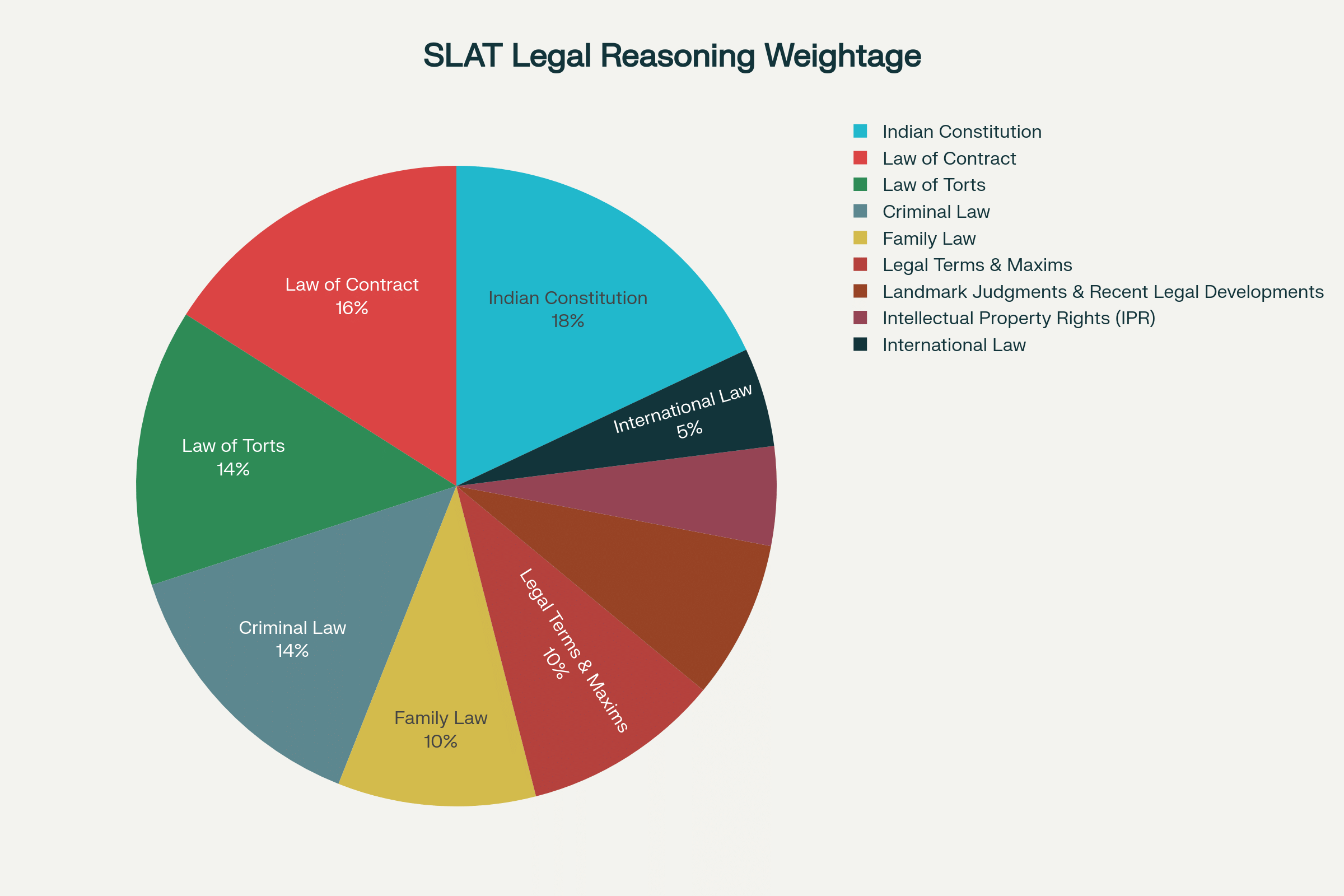
The image provides the weightage of different subtopics under SLAT legal reasoning
Also Check -
What are the most scoring topics in SLAT?
Types of Questions Expected in SLAT 2026 Legal Reasoning
SLAT Legal Reasoning questions are typically of the following types:
Principle-Fact Based: This is the presentation of a legal principle and then a factual scenario. The candidates should use the principle to apply to facts to choose the right answer.
Assertion-Reason: Information is provided with justification, and high achievers are required to determine whether the assertion and the justification are true and whether the justification is sufficient to explain the assertion.
Legal Knowledge: Answers to key terms of the law, maxims and landmark decisions.
Case Studies: Hypothetical scenarios in which legal reasoning is necessary to ascertain the result.
Quick Links:
| SLAT 2026 Syllabus | SLAT 2026 Exam Pattern |
|---|---|
| Best Books for SLAT 2026 | SLAT 2026 Preparation Tips |
SLAT 2026 Legal Reasoning Expected Weightage: Topic-wise Analysis
Add CollegeDekho as a Trusted Source

The Legal Reasoning section in SLAT consists of 12 multiple-choice questions, each carrying 1 mark. Check the SLAT topic-wise distribution of the marks for the legal reasoning and other topics in the table below:
Sub Topics in SLAT Legal Reasoning | Expected Weightage (%) |
|---|---|
| Indian Constitution | 18% |
| International Laws | 5% |
| Legal Maxims | 10% |
| Family Law | 10% |
| Criminal Law | 14% |
| Law of Torts | 14% |
| Law of Contracts | 16% |
| Landmark Judgements and Recent Legal Amendments | 7% |
| Intellectual Property Rights | 6% |
Total | 100% |
Note: Every question is worth 1 mark, and incorrect answers are not penalised. The Legal Reasoning section is one of the significant parts with 20% of marks and this section is important to perform correctly with maximum points.
To score high in the SLAT Legal Reasoning section, one should pay attention to mastering the principles of law, practicing principle-fact questions, and reformulating legal maxims and words. The equal weightage of the section indicates that a good performance at this section can have a huge effect on your overall score. Practice with SLAT previous year question papers , as knowledge of past year trends and a strategy of time management are the major factors that help in cracking this section and securing a place in the best law colleges through SLAT.
Related Articles
| SLAT 2026 Subject Wise Preparation Tips | SLAT 2026 Last Minute Preparation Tips |
|---|
In case you have any other queries, write to us in the QnA zone . Stay tuned to CollegeDekho for more articles!
Are you feeling lost and unsure about what career path to take after completing 12th standard?
Say goodbye to confusion and hello to a bright future!

FAQs
The key topics include the Indian Constitution, Contract Law, Law of Torts, Criminal Law, Family Law, Legal Terms and Maxims, Landmark Judgments, Intellectual Property Rights (IPR), and International Law. Focusing on these areas boosts your chances of scoring well in the SLAT Legal Reasoning section.
Candidates should refer to the Indian Constitution bare act, study guides on Contract and Criminal Law, collections of legal maxims, and compilations of landmark Supreme Court judgments. Online mock tests and legal reasoning practice sets are also highly recommended for timely preparation.
Yes, knowledge of common legal maxims and key landmark judgments in Indian law is crucial. They help you interpret legal scenarios effectively and answer questions that test your legal reasoning and general legal knowledge.
Practice applying legal principles to hypothetical scenarios by solving previous year papers and mock tests. Focus on understanding the rationale behind legal principles and sharpen your analytical and logical reasoning skills for effective problem-solving.
SLAT Legal Reasoning typically consists of 12 questions carrying 1 mark each, with no negative marking. It accounts for 20% of the total exam marks, making it an essential section to prepare thoroughly.
Was this article helpful?

 Quick Facts

















Similar Articles
Private Law Colleges in India Accepting AILET Scores
AILET 2026 Expected Cutoff for All Categories
Can I pursue JD in the US after BA LLB from India?
How to handle technical issues during SLAT online exam?
What is a Good Score in AILET 2026?
Highest Paying Jobs for BA LLB Graduates in India