

- We’re on your favourite socials!


 Solan (Himachal Pradesh)
 Gallery

Related News

KCET 2026 Physics 30 Days Preparation Plan
KCET 2026 Physics 30 Days Preparation Plan is designed to help you to accelerate your Physics preparation with a strategic plan, and revision. For effective preparation and scoring good marks in the Physics section, candidates should follow a schedule which covers the entire syllabus of KCET 2026 Physics. The 30 days preparation plan of KCET Physics is divided into weekly schedules. Dedicate Week 1 for mastering the Class 11 Physics syllabus, Weeks 2 and 3 for the Class 12 syllabus, Week 4 for practising mock tests and the previous year's question papers.
The KCET 2026 exam is scheduled to be conducted on April 16 and 17, 2026. If you are appearing for the exam must note that the KCET 2026 Physics section carries a total number of 60 questions for 60 marks in the exam. By following the KCET Physics 30 days preparation plan, you can score maximum marks and secure admission into desired undergraduate courses in the desired college of Karnataka. The detailed KCET 2026 Physics 1-month preparation plan has been provided here and use it to prepare for KCET Physics 2026.

Predicted Marks Required to Score 99 Percentile in JEE Main 2026
To score 99 percentile in JEE Main 2026, most candidates will likely need to score around 180-220+ marks out of 300. However, this number is not fixed and can change depending on how difficult the paper is and how competitive a particular shift turns out to be.

Total B.Tech Seats in IITs vs JEE Advanced Qualifiers: Is there a need to Increase Seats in IITs?
Clearing JEE Advanced is considered a major academic milestone, as it filters out the best engineering minds from across the country and acts as a final filter for India’s most prestigious engineering institutions - the IITs!

Expected JEE Main Percentile required to be Eligible for JEE Advance 2026
To become eligible for JEE Advanced 2026, a candidate must first qualify JEE Main 2026 by securing a minimum percentile that places them among the top 2.5 lakh candidates (approximately) across all sessions. Only those candidates who meet this condition are allowed to appear for JEE Advanced, as per the official JEE Advanced eligibility criteria 2026.
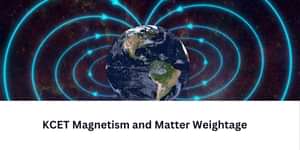
KCET Magnetism and Matter Weightage 2026
KCET Magnetism and Matter Weightage 2026: The Magnetism and Matter chapter is included in the Physics syllabus for the KCET 2026 exam. It carries a weightage of 3-4% in the KCET Exam 2026. The Magnetism and Matter chapter is one of the important chapters in the KCET second-year PUC syllabus. Some of the topics that the KCET aspiring candidates cannot skip for their preparation from the chapter Magnetism and Matter are Retentivity and Coercivity, Gauss law, and Hysteresis Loop. The KCET aspirants can easily score 2-3 marks from the questions asked in this chapter. Candidates should study this chapter properly to gain a good score from the questions asked in this chapter.
To crack the KCET 2026 exam, students must master the KCET syllabus. Practicing the previous year's KCET Previous Year Question Papers will help candidates increase their chances of obtaining good scores in the exam. Candidates should also know what is a good score rank in KCET. We have discussed the KCET 2026 Magnetism and Matter Weightage along with the important topics and some sample questions related to Magnetism and Matter in this article.
Top Courses at School of Engineering & Technology - Bahra University
Related Questions
Admission Updates for 2026
CV Raman Global University Bhubaneswar
Bhubaneswar (Odisha)
GITAM (Deemed To Be University), Hyderabad
Hyderabad (Telangana)
The ICFAI University, Baddi
Baddi (Himachal Pradesh)
Sri Sai University
Palampur (Himachal Pradesh)
Indus International University, Una
Una (Himachal Pradesh)
Related News








Similar Colleges


Explore More Engineering Colleges in Himachal Pradesh
By Degree
By Specialization
By Course

